A farm record keeping app is the first thing many managers look at when they decide to get organised, and often it is the wrong first purchase. The decision you face is not which app. It is whether the records you need justify anything more than a pen and a hard-covered book. This piece sets out what to record, prices the three tool types where the sources let us, and takes a position at the end.
One limit up front. Most of our sources come from the United States, with one South African survey and one World Bank pilot that touched Kenya. Not one of them gives a Kenyan shilling price for any farm app, and none says what happens to your entries if an app company closes. So for those two questions you get a way to find out, not a made-up answer.
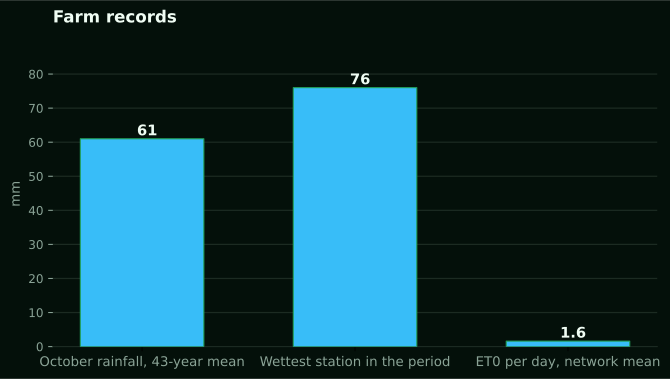
Measured by NuaSense weather stations and soil probes on Kenyan farms, over the period stated with each figure. Past readings, not a forecast.
Four things worth writing down
Your brief put inputs, labour, sales and rain at the top. That lines up with what the extension services say. Wisconsin Extension puts crop records as yields, inputs like fertiliser and seed, pesticide application, irrigation, and planting and harvest dates. For weather, it covers precipitation, wind, and storm events such as hail.
The University of Georgia's farm business guidance says good records show where profits or losses turn up across different crops and animals. For fruit and vegetable growers, it names varieties, yields, inputs, seed costs and planting dates. For animals, it adds herd size, animals sold, feed costs and veterinary costs.
Labour is the line most growers leave out, and it is the one that keeps a margin honest. The Veggie Compass tool UGA describes works out each crop's cost per pound, breakeven price, and gross margin by market channel, using expenses, sales and production labour hours. Drop the hours column and the margin looks better than it is.
Put the full list on a single page and tape it inside the store door. Date, field or block, what went in (product, quantity, cost), who worked and for how long, what came out and who bought it, and rainfall. That is seven columns. If your tool cannot hold those, it is the wrong tool. If it asks for a lot more, you will stop filling it in.
Why the system should be simple before it is clever
Wisconsin Extension makes a point that should get more attention than the software lists around it: no single record keeping system is best for every situation, and records that are too complicated can lead to mistakes or avoidance. Avoidance is the real failure. A perfect app left in week six produces nothing.
That same source says records serve financial statements and management decisions, not just income tax. Michigan State University calls collecting farm data a preemptive necessity for analysing financial performance and improving management decisions. Both tax references are American, and Kenyan compliance rules are different, so ask your own accountant what the Kenya Revenue Authority expects from a farming business.
UGA lists three financial documents that your records should eventually feed: a balance sheet, an income statement and a cash flow statement. Most growers will never put together all three on their own. The raw entries just need to be clean enough that an accountant can build those statements without a week of guessing.
The test for any tool is simple. Can the person who does the daily work, maybe a supervisor with a basic phone, enter a day's inputs fast and without help? If the honest answer is no, then how sophisticated the tool is does not matter. The cheapest option that person will use wins. Before you buy anything, ask that person, not the owner. The owner is rarely the one in the field with a wet pen at six in the evening. A system built around the owner's habits will fail on the supervisor's.
There is a second test. It looks at your weakest week, not your best one. Records fall apart at planting and at harvest, just when they matter most, because everyone is busy. Choose the tool that gets through your worst week. A notebook with five lines filled in beats an app with a dashboard and nothing behind it.
The notebook: cheap, slow, and still defensible
Wisconsin Extension describes the paper method as a shoebox, pen and paper, a notebook, or a ledger book. Its verdict: it takes more time and can bring possible errors, but costs little and suits farmers who are not familiar with computers. That verdict is balanced, and it is the right one.
Cornell's small farms guidance gets more specific. Under the shoebox method, sales receipts go in one folder, expense receipts in another, and there is a capital asset depreciation log. It is simple and easy, but the data is not well organised. You end up sorting piles of paper and doing every computation by hand.
Cornell also gives prices for the printed option. The Cornell Farm Account Book is listed at $20 and the Classic at $15. The printed option is easy to understand and well laid out, though it may not match how you want to work. Cornell warns that hand entry takes real time every week. Those prices have not been converted. They are American list prices for American books, mainly useful as a sense of scale.
So where does that leave a Kenyan block? A ruled exercise book and the seven-column page above cost very little. They need no charging, no airtime and no signal. The cost comes at month end, when you spend your evenings adding columns by hand. For a farm with one or two enterprises and one person keeping the book, that is a fair trade. For a farm with several crews, it is not.
The spreadsheet is the compromise that lasts
Cornell calls a basic spreadsheet in Excel or a similar program a good middle ground between paper and more sophisticated programs. Its sharper claim is this: if you do not need to generate invoices and you run a relatively simple, small operation, a spreadsheet may serve you well for many years. Years, not seasons.
Wisconsin Extension puts Microsoft Excel and Google Sheets at the top of the list for spreadsheets. Then it names other packages: CenterPoint, Farm Biz, QuickBooks, Quicken, PCMars and Ultra Farm Accounting. What they cost varies, and you'll need basic computer knowledge to run them. The source gives no prices, so neither do we.
With Google Sheets, one thing matters when a product dies: the file belongs to you, and other programs can open it. You can download a spreadsheet, copy it to a flash disk and email it to your agronomist. That's about the file format, not about any company's shutdown policy. None of our sources talk about shutdown policies. Check any provider's terms yourself.
The phone is the weak point. Typing across a dozen columns on a small screen is miserable, and a field supervisor won't do it. A pattern that works: paper sheet in the field, then a weekly typing session by whoever's in the office. You keep the cheap capture and gain the arithmetic.
What the Sireet pilot actually shows about apps
The strongest Kenyan-linked evidence is the World Bank's Digital Farm project. In Sireet, Kenya and Bushenyi, Uganda, it captured and analysed weather data at individual farmer level for the first time, and digital logbooks fed back to farmers and producer organisations gave first-time insight into farm health.
Training included Lead Farmers on a prototype digital record-keeping app and on installing and using Climate Edge's Nexo Weather stations. The project reports 394 people actively using the logbooks and the FarmDirect App. That figure is the one to hold against the hype.
Now the training numbers. In 2019, 4126 smallholders were directly trained across Kenya, Uganda and Tanzania, with 16,504 people benefiting indirectly. Those are three countries, so don't read either figure as Kenyan. And 394 active users against 4126 trained is not a like-for-like ratio. The first is tied to the logbook app, the second to the wider project. We won't divide one by the other.
What the pilot does show: an app can work if someone trains the users, and a developer based in Nairobi keeps talking with a network of Youth Leaders so the logbooks stay accessible. It reports use and training, not a controlled yield result. An app with no such support behind it is a different product.
For a buyer, the lesson is about what surrounds the software, not the software itself. Ask who will train your supervisors, who answers when an entry goes wrong, and who feeds results back to the people who typed them in. In the pilot, logbooks went back to farmers and producer organisations, and that loop turns entries into decisions. A record nobody reads again is just a chore.
Phones are everywhere and still underused
That study of 220 emerging growers in the Eastern Cape of South Africa comes from South Africa, not Kenya, and the Eastern Cape is not our patch. Even so, it can work like a mirror. Researchers found that most smallholders in that area turn to information systems for farming and agribusiness work, and it reports better productivity and food security among rural households.
The apps named in the study are Facebook, Twitter, YouTube, LinkedIn and WhatsApp. Look at what that list is: tools for sharing, not for keeping records. According to the study, these apps can reduce information asymmetry and close the distance between large and smallholder farmers. But it also says growers still do not use the medium fully, and that they ran into problems when using information systems on their farms.
For a Kenyan agrovet, that points to a simple WhatsApp habit using the phone already in everyone's pocket: every Friday, take a photo of the notebook page and send it to yourself or your manager. This is not a farm app, and nobody should act like it is. It is a free backup of paper, and it can cover you if there is a house fire or a lost book.
Which dedicated apps actually last in Kenyan hands is another question, and the site has already covered it in which farm apps Kenyan growers actually keep using. Read that before you pay for anything.
Trials set the recording burden before the season starts
If you ever compare one input against another on your own land, say two fertiliser rates, the design decides how much you must record. According to Mississippi State Extension's RIGOR guide, four to six complete blocks are enough for most on-farm trials.
The arithmetic in the guide is worth copying. One factor at four rates, replicated in three fields, needs 12 strips. Add a starter fertiliser at three rates and the full combination is 4 x 3 = 12 combinations, times 3 replicates, which gives 36 strips. If you treat the two factors separately, you need 12 plus 9, so 21 strips.
Each strip needs its own line in your book. The guide says to record each strip separately, never lump replicates into an average, draw a map with the strips labelled, count rows for each treatment, and describe the product and rate. It also suggests a coding scheme such as 1A, 1B, 1C to avoid bias, and to write down what each code means.
So 36 strips means 36 lines per visit. A notebook will struggle with that; a spreadsheet will not. That is a good reason to pick a tool based on the heaviest recording job you plan, not the lightest one. The design choice, 36 strips or 21, is also a record-keeping choice, and you make it before a single seed goes in. Decide how much you are willing to write down, then design the trial to fit.
Weekly visits, verbal deals, and what agrovets should avoid
Senior researchers should walk each trial at least once a week, according to FAO's trial methods guidance, and be there when treatments go on and at key moments like harvest. Most farm managers won't manage that on every plot. The idea still holds though: whoever is in charge should watch the application, and the note goes in the book that same day.
FAO adds that a deal between a farmer and a researcher may be spoken, not written, as long as both sides know exactly what they have agreed. It also warns against reward or insurance clauses, like promising a set level of return.
That rule is practical for an agrovet helping customers with records or a demonstration plot. Put the agreement in the book the same day, with both names on it. Don't promise a yield. If the season goes badly and you gave a guarantee, the farmer has a grievance, and your own records become the evidence against you.
Plot size follows the same thinking. FAO notes that in semi-arid Botswana, plots of at least 6 m by 20 m have been used where planting and fertiliser spreading are less precise. For animal-draught tillage trials, 40 to 50 m by 10 to 15 m. With tractors, up to 0.5 hectares. Those are Botswana figures. Choose your own size, then write it down.
Rain is the one record a tool can fill for you
Weather appears on every list above, and rainfall is the one people forget or guess at. A bucket gauge on a post, checked each morning, is the cheap way out. It costs one line in the book and a minute of your time.
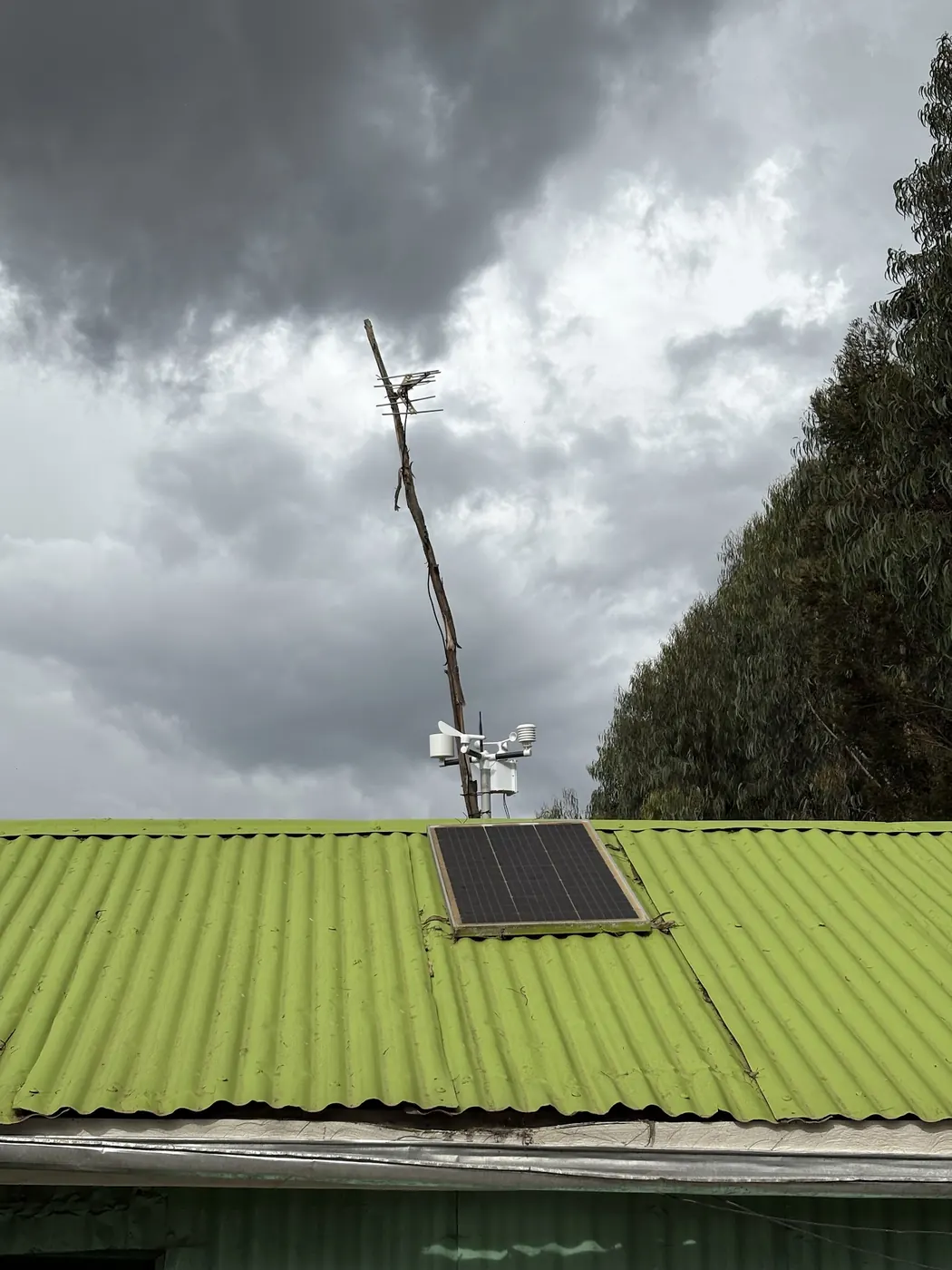
Automation makes a thin case here, but a real one. The NuaSense weather station costs KES 30,000 before taxes, reports rainfall in millimetres about every 10 minutes, and the dashboard comes at no charge. In our own network from 11 September to 11 October 2026, station rainfall totals ran from 0.4 mm to 76.4 mm across 4 stations that are not co-located. That spread is exactly why your own gauge beats the neighbour's number.
Does it pay for itself? If all you need is rainfall in the book, probably not. A manual gauge does that job. It earns its keep when you also want wind, humidity or leaf wetness, or when no one can reach the gauge at a regular hour. The earlier piece on farm tech choices compares apps, sensors and extension. For a wider view of what a station adds, see NuaSense's overview of IoT applications in Kenyan agriculture, covering low-cost sensors and mobile platforms.
Putting the three side by side, and taking a position
Here is the comparison, limited to what the sources support.
- Notebook or ledger: minor cost, suits people unfamiliar with computers, but slower, more error-prone, and every sum is by hand. Printed account books are listed at $15 to $20 by Cornell.
- Spreadsheet: a good compromise, may serve a small, simple operation for years, needs basic computer knowledge, and does not generate invoices on its own. You own the file.
- Farm app or software package: costs vary and no source gives a Kenyan price, so ask for it in writing. Real-time statements, but the Kenyan pilot data shows 394 active users, and it took trained Lead Farmers and a developer in Nairobi to get there.
- Outsourced accountant: the highest cost, and monthly statements take a few weeks to come back, against real time on an on-farm computer system.
My position: begin with paper. Move to a spreadsheet once you run more than one enterprise or any trial with many strips. Buy an app only after you have kept paper records for a full season without gaps. An app doesn't create the habit. It stores one. If you can't name who enters the data on a wet Tuesday, don't buy anything.
On the dead app question: no matter which one you pick, export your data every month to a file you control. Ask each vendor, in writing, how you get your data out. Our sources don't say what vendors do, so test it before you pay, not after.