Measured by NuaSense weather stations and soil probes on Kenyan farms, over the period stated with each figure. Past readings, not a forecast.
The decision, as it reaches a plot on the first wet morning
A grower with three acres of maize ground and the first rain on the roof has one decision that cannot wait: hand planting with a jembe and a string line, or a planter machine. In Kenya that choice has three practical shapes. A hand-held jab planter, an ox-drawn unit, and a tractor planter that usually arrives through a hire service rather than on your own trailer. The rest of this piece is about whether any of them earns its cost on your acreage, and it starts with an admission. The sources checked for this article hold no purchase price and no hire fee for any of the three. Anyone who quotes you a planter price in a blog post pulled it from a catalogue or from memory, and catalogues move.
One Kenyan adoption figure survives checking, and it comes from a 2023 CGIAR study of mechanisation hire-service models in four Kenyan counties: 30 percent of the farmers surveyed used a jab planter and 20 percent used tractor planters. Read that carefully. The study covers four counties, picked because hire services operate there. So it describes places where the option exists, not a national rate. Even so, where a planter is on offer, half the farmers in that sample had already moved off pure hand planting, and the hand tool was the more common pick. The rest of the evidence points the same way. The jab planter is the tool most Kenyan plots can justify. The tractor planter is the tool a group can justify. The ox-drawn unit sits in a gap in the record: the ministry names it as a category, and nobody whose work made it into this fact bank has tested it.
Four tools, side by side
The comparison below sticks to what the sources actually say. Where a cost row is blank, that is because no source carries a figure. A blank is more honest than a number dressed up as research.
- Hand planting with jembe and string: nothing to buy. Depth and spacing are set by each worker and drift with fatigue and with who is holding the hoe. Labour is the whole cost. Right call on the smallest plots and wherever the household already supplies the hands.
- Jab planter: a hand tool stabbed into the ground once per station, dropping seed from a hopper. Depth depends on the user and on how hard the soil is. One worker, no animal, no fuel. Used by 30 percent of farmers in the four-county CGIAR sample. Purchase price: not in any source checked.
- Ox-drawn planter: an animal-pulled unit that opens a furrow, drops seed and covers it. Listed as a mechanisation type by the ministry, and that is the full extent of the evidence. No source here costed, tested or compared one.
- Tractor planter, hired: multi-row unit, often a direct planter that tills, plants and places fertiliser in one pass. Used by 20 percent of farmers in the CGIAR sample. Reached in Tharaka Nithi by hire through farmers' groups rather than purchase. Hire fee: not in any source checked.
The Ministry of Agriculture's national agricultural mechanisation policy lists animal-drawn and motorised machinery among the main mechanisation routes in the country. That is why the ox-drawn row stays in the table even with the evidence behind it empty. A policy category is not a trial result. If a fabricator offers you an ox unit, ask for depth and spacing measurements from a real field. The published record cannot supply them.
Depth is the fault you see too late
Depth is the strongest argument for a planter, and depth is also the strongest argument against one that is badly set. Iowa State's planter maintenance guidance says a maize kernel has to soak up 30 percent of its weight in water before it will germinate, and that the first 48 hours in the soil are a critical window. That was written for Iowa, where the planter is a tractor unit and the soil is not yours. The mechanism transfers whole. Seed lying in a shallow, open furrow dries before it has drunk enough. Seed pushed too deep into a crust burns its reserve getting out. A string line and a jembe give you whatever depth the worker's wrist gives at that moment, and the wrist changes between eight in the morning and noon.
A jab planter fixes the mechanism, not the operator. The beak goes in as far as the person pushes it. A tired worker on a hard patch plants shallow, and a fresh one on a soft patch plants deep. That is still an improvement, because one person's push varies less than four people's hoes, but the gain is in consistency, not a guarantee. On the tractor unit, downforce does the same job. The Wisconsin extension primer on precision planting notes that reduced ground contact under the gauge wheels tells you a planter is struggling to hold depth, and that downforce also sets furrow structure and seed-to-soil contact. The same primer describes automatic depth control run by a seed-trench moisture sensor that keeps going deeper until it finds moisture. That hardware is not what arrives on a hired unit in Kenya. The lesson is simpler. If the hired planter's gauge wheels are bouncing on a rough seedbed, the depth it promises is not the depth you are getting. Dig behind it on the first pass instead of trusting the operator's word.
Skips, doubles and the headland that gets planted twice
Spacing failures come in two kinds, and they are not equal. Iowa State puts it plainly: doubles waste seed, but skips have the largest negative impact on total yield. A double is two seeds in one station, competing with each other. A skip is an empty station producing nothing, and nothing cannot be averaged away by the neighbours. Hand planting gives you both, because a worker's count drifts. A jab planter with a worn or mis-set seed plate gives you doubles consistently, which at least is a fault you can find in one row and fix once.
The expensive version of a double is a whole area planted twice, which is what happens where a tractor planter turns. A Wisconsin summary of a 2014 study by Runge and colleagues reports that double-planted areas, usually headlands, lost an average of 17 percent of maize grain in that area once yield and harvest losses are counted. That figure was measured on American fields. What transfers is the geometry. Wisconsin's worked example compares two fields of 13 acres each: one has a 3,010-foot perimeter and a perimeter-to-area ratio of 231, the other a 4,891-foot perimeter and a ratio of 376. The field with the longer edge carries more headland for the same area, so a bigger share of it is at risk of being planted twice. Wisconsin's point is that automatic row shut-offs pay better on the high-ratio field, though it adds that the ratio method suits long strips of consistent width poorly. No Kenyan plot in this fact bank has shut-off equipment, so the practical reading is different. A small, irregular Kenyan plot carries a lot of edge for its area. Put a hired tractor planter on one and a large share of the pass goes into turning, and every turn is a chance to double. That is a real argument for the jab planter on small ground: it has no headland problem, because the operator can see the last station.
Before you blame the tool for a gap in the row, Auburn's planter troubleshooting guidance advises digging the soil to confirm a suspected skip is a true planter skip, because seed may be there and simply not have emerged for other reasons. Auburn also notes that planter faults are common and hard to notice, especially on planters without a seed monitor, and a hired unit in Kenya will usually be one of those. The dig test costs nothing. It separates a planter fault from a seedbed fault, and you cannot decide whether a tool earned its money until you know which one you have.
Passes removed
No source in this bank gives a labour-hours figure for Kenyan planting, so this section cannot say how many person-days a jab planter saves on an acre. It can name where the saving sits. Hand planting means at least two jobs at each station: open the hole, drop seed, cover. A jab planter folds those into one motion by one person. A tractor direct planter of the kind FAO describes in Tharaka Nithi folds in more: those units till, plant and fertilise in a single pass, and the stated aim of using them was to reduce ploughing and limit soil disturbance. Every pass you remove is a day of labour or a tractor hire you do not spend, and that is where the larger machine makes its case, more than the planting itself.
Utah State's no-till guidance puts the economic case for no-till as reduced labour, reduced equipment cost and reduced fuel. It was written for dryland wheat in the American West, but the arithmetic still holds on a Kenyan block: the tool that lets you skip a ploughing pass earns the price of that pass every season, before any yield effect is counted. Utah also warns that benefits in the soil itself take time, with measurable change often only after six years in dryland systems and from about year three under irrigation. Those timelines were measured in Utah soils and should not be pasted onto a Kenyan field. The direction of the warning transfers. Hire the one-pass planter for the pass it removes this season, and treat anything the soil does later as a bonus. The earlier piece on this site comparing tractor hire against the ox plough on a smallholding worked through the same logic for primary tillage, and its conclusion carries over: the saving is real only when you were going to pay for that pass anyway.
The fertiliser hopper is the quiet part of that pass. Utah State is blunt: under reduced tillage, surface broadcasting is not an effective agronomic or economic choice for immobile nutrients like potassium and phosphorus. Those should be placed at or below seed level at or before planting, and specialised planting equipment is what makes that possible. The nutrient chemistry belongs to the agronomy sites. The mechanical point stands anywhere. If you were going to band fertiliser by hand, a pinch per hole, the hired planter removes that job as well as the planting job, and the comparison tilts further toward hire than planting speed alone suggests. If you broadcast and move on, the hired planter gives you placement you were not paying for, which may be worth having but is not a saving.
Hire through a group before anyone talks about buying
The most useful Kenyan evidence in this bank is about ownership, not machines. In the FAO-supported farmer groups in Tharaka Nithi, members reached direct planters by hiring through their farmers' groups and community-based organisations rather than buying, alongside cheaper loans for seed, fertiliser and pesticides. The unit doing the hiring is small. Each group has 15 to 30 farmers, and a few groups together form a CBO normally registered with the county government. Since 2015 some 15,000 farmers in southern and central Kenya have joined groups of this kind and sell collectively. Members described expanding from one acre to four, with some reaching 20 acres.
Two points need saying about that expansion. First, the FAO story bundles the planter with group marketing, conservation agriculture training, moisture testing and threshing. So the growth in area and the better sorghum prices those farmers reported cannot be credited to the planter on its own. Second, and this is the part that matters for your decision, the growth happened in groups that never bought the machine. So ask an agrovet not what a tractor planter costs, but what is the smallest group near me that could hire one, and is it already registered with the county? Fifteen to thirty farmers at one to four acres each is somewhere between 15 acres and 120 acres. That is the size of block that keeps a hired multi-row unit busy for more than an afternoon. One farmer with three acres does not. The same reasoning drove the piece on this site about spray drones against a knapsack: a machine that does an acre quickly is only cheap when there are enough acres queued behind it, and the queue is what the group provides.
This also answers the question nobody in the bank answers directly: the acreage where a planter pays. No source gives a break-even. But the only documented Kenyan route to the big machine runs through a group of a known size, so the threshold you can use is the group, not the hectare. If no group near you is large enough to fill a day of the operator's time, the tractor planter is not your decision to make yet. The jab planter or your own hands are the whole menu.
The rains set the window
A planter does not change how much you plant. It changes how many days you need to plant it, and that is only worth money if days are scarce. They are. An Agris-indexed modelling study of Kenyan maize farmers' planting strategies found that access to extension and machine services, distance to the maize plot and the time of onset of the rains all significantly influenced how farmers planted. The same study found population pressure and agroclimatic diversity to be important determinants of planting regimes. It concluded that high-population, bimodal-rainfall mid-altitude zones needed shorter-maturity varieties and efficient double cropping. Variety choice belongs to the sister sites. What matters here is the mechanism: in a bimodal zone the second season is short, so the days between onset and the end of the sowing window are the whole value of a planter. On a long single season that value shrinks.
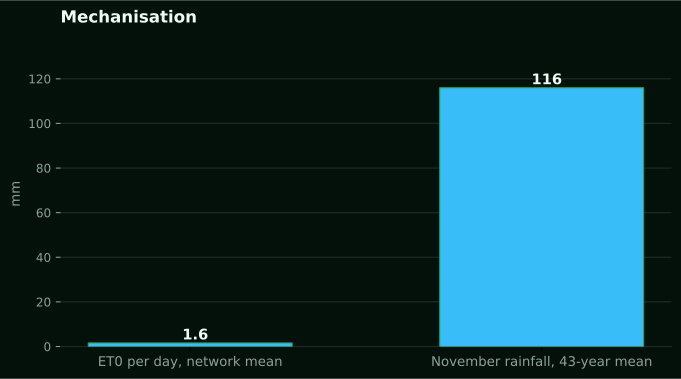
Rain starts locally. Between 02 October and 01 November 2026, 12 NuaSense weather stations in Kenya recorded totals running from 0.0 mm to 118.4 mm. Those stations sit far apart, and the spread is no map of any region. It only shows that one station had a wet month while another got nothing, and that the planting day on your plot is set by your plot. For the grid cells where our stations stand, the CHIRPS satellite-and-gauge record puts long-term November rainfall at an average of 116 mm over 43 years, with the driest November at 47 mm in 1983 and the wettest at 294 mm in 2019. That is a modelled historical product. It is not a gauge on your farm and not a forecast. A NuaSense station at KES 30,000 excluding taxes records your own rainfall in millimetres about every ten minutes. So the decision a planter compresses, which day to start, rests on a measured number rather than a neighbour's report. It will not tell you when the rain will come. It will tell you, with a timestamp, when it did.
A feature phone beside the hand tool
Most growers weighing a jab planter against a string line will not put a station on the plot. The sources say what they use instead. PlantVillage's account of the iShamba hotline reports roughly over 500,000 users across Kenya, signed up by texting JOIN to 21606 or dialling *384*101010#, and puts the cost of sending 350,000 SMS messages a week at 1,800 US dollars. In a 2022 survey of 4,272 Kenyan farmers, 3,577 said the forecast SMS helped them and 605 said it did not. Of those helped, about 51 percent said it helped them plant on time. Another 23.15 percent said it helped plan farm activities, 22.59 percent said it helped decide what to plant and 3.27 percent said it helped them get inputs early.
Half the farmers who found the message useful found it useful for timing. That is the same lever the planter pulls. Put a jab planter in the hands of one person who knows which morning to start and it is a different tool from the same planter waiting for a cousin to confirm the rain has really come. The pairing is cheap: a feature phone and a hand tool. No fuel, no animal, no group meeting. Depth is where it falls short. No SMS will tell you the beak went in too shallow on the hard strip by the gate. That still needs a trowel and the dig test from Auburn. NuaSense SMS and WhatsApp alerts cost 0.03 US dollars per message and can be switched on, off or changed in frequency at any time. The difference from the hotline is that an alert from your own gauge reports your own rain rather than a district message.
Check the old tool for free before paying for a new one
Every planter fault in this bank has a check that costs time and nothing else. Iowa State does its pre-season depth calibration on a level surface, using blocks the width of the intended planting depth or a commercial depth tool, so each row unit's setting matches real field depth. Its scribe test sets the planter on a level concrete pad at the shallowest setting, drives forward five feet and expects the scratches to come out perfectly centred over the line. The wear limit for openers is specific: replace a standard 15-inch blade once it wears to 14.5 inches. Incorrectly shimmed openers leave a W-shaped furrow that seats the seed badly and exposes it to air pockets. Auburn lists that same W-shaped furrow from worn discs, plus gauge-wheel wobble and too much gap between gauge wheel and disc, among the planter causes of uneven depth and emergence.
None of those checks were written for a jab planter. A jab planter has no gauge wheel and no blade you can measure in inches. What carries over is the habit, not the tool. Stab it ten times into a level patch of your own seedbed, dig each station and measure the depth with a ruler. If ten stabs give you a scatter wider than you would accept from a worker, the tool is not the fix. Utah State's tenth no-till mistake is believing that new or expensive planting equipment is always needed. Many producers, it reports, got the same result from existing or modified gear: row cleaners, wavy coulters, deep-placement fertiliser disks, heavier down-force springs and extra frame weight. That list is for tractors, but the principle is the whole point of this article. Before you hire a bigger unit because the hand tool plants unevenly, find out whether the unevenness is the tool or the person. The second is free to fix. And no planter rescues a weedy field. Utah's rule is never to plant into emerged weeds and to keep the field clean for six to eight weeks after planting, which is a crop protection job, not a planting one.
Where each tool is the right call
If the household can plant the plot by hand in the days the rains allow, buy nothing. The 48-hour window and the depth problem are real. Even so, a careful worker with a string line and a trowel check beats a jab planter used carelessly, and the money is better spent on knowing which day to start. Once hand planting is spilling past the sowing window, the jab planter is the first purchase. It is the one most Kenyan farmers in the CGIAR sample chose, it needs no animal or fuel, and its faults are all visible to the person holding it. The ox-drawn unit is a legitimate category under the ministry's own policy. If you already keep trained oxen and a fabricator you trust, ask for depth measurements from a real field before paying, because nobody in the published record has done that work for you.
A tractor planter is a group decision, not a farm decision. The Tharaka Nithi groups of 15 to 30 farmers got theirs by hire through a county-registered CBO and never bought one. The one-pass tillage and fertiliser placement it offers only saves money when the group was already paying for those passes. If you are one farmer with a few acres and no group, the hire quote you are offered will be priced for the operator's afternoon, not your plot. A high-perimeter smallholding also gives that unit plenty of turning and plenty of headland to double on. Dig behind it on the first pass, every time. A piece on NuaSense's own blog about raising crop yields in Kenya covers soil fixes, water strategies and seed choices in that order. Its argument that yield gaps usually start in the soil is why placement, rather than speed, may be the thing you remember the hired planter for. The tool rarely fails on its own. It fails when it is bought for an acreage that cannot keep it busy, or hired for a seedbed nobody checked.