Begin with the figure that belongs under any buying choice on a Kenyan smallholding. A maize farmer working alone gets around two tons per hectare. Put inputs, mechanization and training together, and that rises to five to seven tons, according to the World Bank's Disruptive Agricultural Technology Challenge and Conference. The gain comes as a package. No one sensor, app or drone did it by itself. Any vendor who says otherwise is selling you the bundle's result at the price of one piece.
This is not another agritech Kenya trends roundup. Smart farming in Kenya has the landscape covered already. What comes next is a sorting job: which tools a five-acre farm can really run, what each costs to bring onto the farm, and what must happen before it pays that back. Some categories do help a five-acre block. Others were built for a bigger operation dressed up as smallholder kit. A few cost nothing and beat the paid option.
Measured by NuaSense weather stations and soil probes on Kenyan farms, over the period stated with each figure. Past readings, not a forecast.
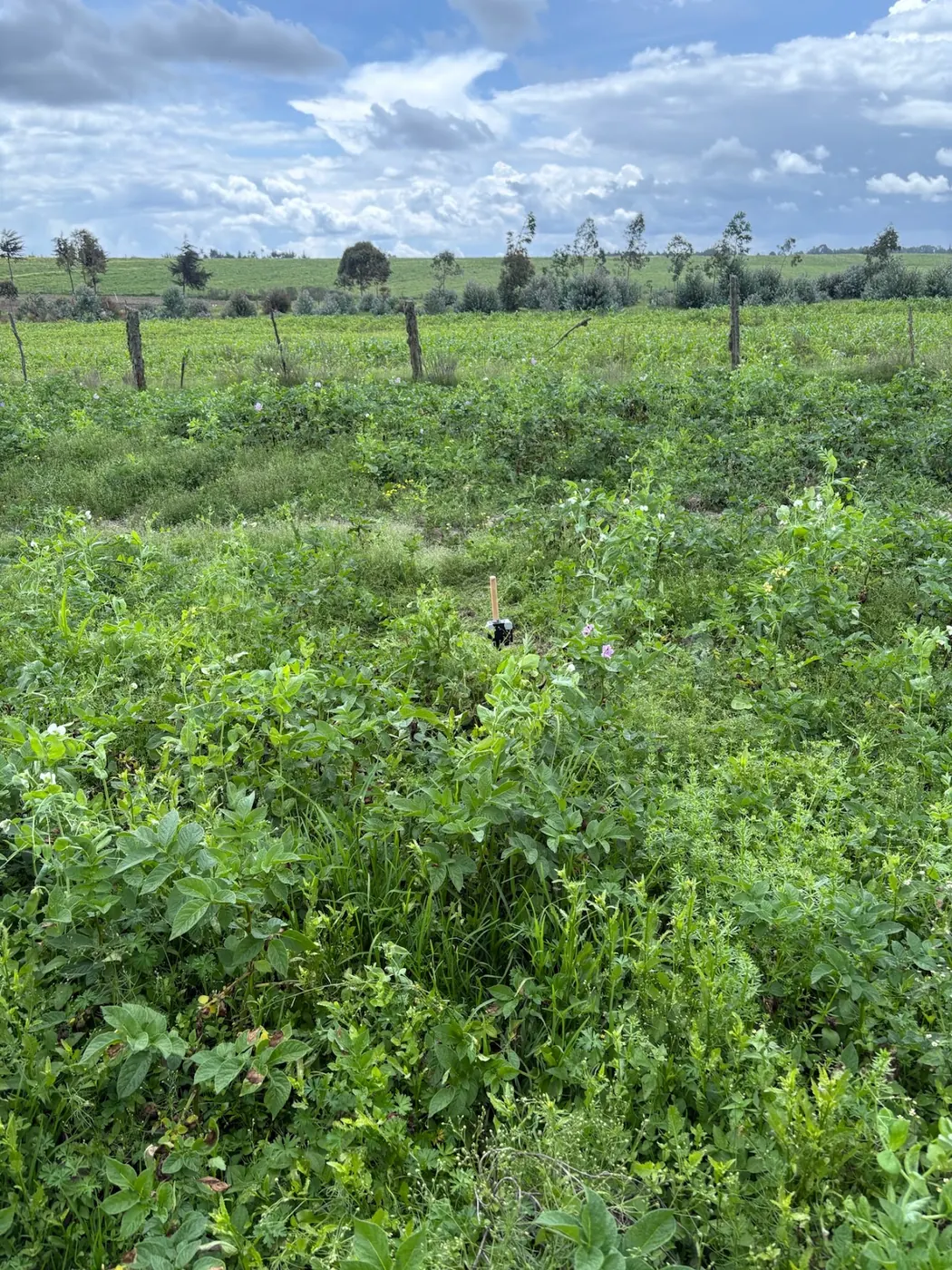
The channel matters more than the technology
The World Bank's DAT Challenge groups Kenyan agritech into four themes: advisory and information, market linkages, financial inclusion, and data analytics. Under those labels, what really separates tools is the route that reaches the farmer, not the tech itself. Digital Green sends advisory content through group video screenings. Precision Agriculture for Development puts personalised advice on the farmer's own phone. Farmers Pride uses a village youth agent who turns up in person. Hello Tractor uses an app that links a tractor owner to a farmer requesting the service.
For a five-acre farmer, picking among these is not about choosing higher or lower sophistication. It is about whether you want a group session, a text message, a visiting agent or a booking app. If the closest agricultural extension officer at ward or sub-county level is the real bridge to any of this, know what that officer is trained to use. The ILRI reference guide on Climate Risk Management in Agricultural Extension sets a working knowledge of web browsers, Word, Excel and PowerPoint as the floor for extension agents on that course. An app that assumes a smartphone-fluent farmer can still stall if the person meant to support it locally works from a laptop and a training manual.
The practical rule: before you take up a tool, ask who stands between you and it. A video screening needs a group and a facilitator. An SMS advisory needs a working number and nothing more. A youth agent needs that agent to keep showing up. No channel here is inherently better. They break down in different ways, so a five-acre farm should choose the failure mode it can live with, not the one with the newest name.
Mechanisation you rent, not buy
Owning a tractor on five acres rarely makes sense. The FAO's 2023 stocktake, Taking stock in Kenya, Rwanda and Uganda, records that much farm work in the region is still done by human power, and that comes with real productivity and health costs. It also says plainly that earlier pushes to mechanise African agriculture failed, mainly because the machines were not integrated into the wider development framework around them: financing, spares, service, markets. A tractor without that support structure is a liability, not an asset.
Hello Tractor is built on hire, not ownership. Farmers ask for tractor services through the app, while the owner gets remote asset tracking and virtual monitoring, so the machine's location and use stay visible. That detail matters more than it looks. It means the hire model's economics depend on the owner trusting that the asset will not disappear or get abused, not just on how convenient booking is for the farmer. If you are the one hiring, this is good news. Owners have a reason to keep supply in your area instead of pulling machines back to safer ground. This site has already worked through the land preparation trade-off between tractor hire and the ox plough, and that conclusion stands: timeliness at the start of the rains usually decides it, not the sticker cost of the service.
The FAO stocktake also notes that mechanization is seeing a resurgence, especially in African Union policy circles. That signals where subsidy and programme money is heading. It is not a signal that a five-acre farm should buy equipment now. On this acreage, the honest position is simple: rent through an app-based hire service where one operates near you, and treat ownership as something that only starts to make sense once your land, or your neighbours' pooled land, is big enough to keep a machine working most of the season.
Solar irrigation, and the financing question that actually decides it
The DAT Challenge material says Ninety-eight percent of Kenya's agricultural systems depend on rain. That is why smallholders hear a hard pitch for solar pumps as soon as a dry spell starts. SunCulture sells solar-powered irrigation kits and, distinctively among the tools in this group, helps arrange financing for the acquisition. For a five-acre budget, that financing detail is the whole story. The World Bank's own figures on Kenyan agricultural finance are blunt: only 10 percent of smallholders can access financial services including credit and insurance, and only 4 percent of total credit supply in the country flows to agriculture at all. Reasons named include unreliable data for lending, a lack of collateral, high transaction costs to reach rural areas, and no data platform for assessing risk.
Put those two facts together, and the question is not which pump is better. It is which seller can actually get you the money to buy one. A solar irrigation kit a farmer cannot finance is not cheaper than one they can finance; it is simply unavailable. That is the mechanism behind why vendor-financed hardware tends to beat outright purchase on a five-acre budget. According to the same World Bank material, credit elsewhere in the economy costs enough that Kenyan farmers show weak demand for it even when they need the asset. If a solar pump vendor has no financing path and no local service arrangement, look at the sticker price as the smaller of the two obstacles.
This does not claim solar irrigation pays for itself on any particular acreage. No figure in the source material puts a number on that. The claim is about order: settle the financing and service question before you compare pump specifications. At this scale, financing is usually what actually blocks the purchase.
Livestock and input platforms: aggregation, not automation
DigiCow is a mobile platform. It connects small livestock owners to veterinary services, artificial insemination and feed suppliers by pulling demand from many small farmers together into a bundle a supplier will actually serve. That is a different kind of value from what a sensor or a drone gives you. It measures nothing on your farm. What it solves is that one five-acre livestock keeper is too small a customer for a vet or an artificial insemination technician to visit economically alone. A platform that aggregates hundreds of such keepers is worth the trip.
Farmers Pride uses similar logic, but from the input side. It is a franchise model that pairs technology with village youth agents to close gaps in inputs, services and information for rural smallholders. Neither tool here asks the farmer to buy hardware. They ask you to sign up and to trust an intermediary to deliver the aggregated service reliably over time. That risk is different from the risk of a broken sensor.
These platforms appear in an article that is otherwise about hardware and cost because they are the right baseline comparison. Before you spend on a weather station or a drone pass, ask what your actual constraint is. Is it information you do not have, or access to a service you cannot reach alone? If it is the second, an aggregation platform is very likely the cheaper and more direct fix. It needs no purchase at all.
Selling on time: the information gap that costs real money
Eighty-three percent of Kenyan farm households sell part of what they grow. So market timing matters to most five-acre operations. It is not a niche concern for large commercial farms. The World Bank material is specific about the failure mode here: when rural farmers sell at harvest, they face asymmetric information about prices and selling opportunities. Often the limiting factor is not connecting with a buyer in time.
This follows on from Farm tech in Kenya: apps, sensors, extension or automation?, which covers Farm tech in Kenya: apps, sensors, extension or automation?.
Related reading on this site: crop protection, irrigation optimisation.
This is squarely a data-platform problem, and it should be kept entirely separate from the sensor-and-drone conversation. It needs no on-farm hardware. A phone with SMS or a basic advisory app carrying price information solves a timing problem, not a measurement problem. This site's earlier piece on farm gate, market or aggregator channels covers where the money actually goes once a buyer is chosen. The tools discussed here sit upstream of that choice. They tell you a buyer exists and what they are paying before you commit a truckload.
Kenya's draft Agricultural Data, Information and Digital Policy puts KADIC, the Kenya Agricultural Digital Information Centre, in charge as the institutional mechanism for coordinating agricultural data management and digital service delivery across the country. KADIC is a coordination body. It is not a farmer-facing app, and the draft policy does not impose any binding duty on a farmer to use it. The signal is this: market and price information in Kenya is moving toward a more coordinated national route, not a patchwork of competing private apps. That matters if you are picking a data platform and expect it to still be around in three years.
Sensors: what they measure, and what they cannot substitute for
The DAT Challenge has a category for low-cost precision agriculture devices for Kenya. It includes ICT, drone surveillance, satellite GIS, weather data analytics, blockchain and the Internet of Things. The document calls these emerging low-cost options, not proven ones. No figure in that material claims any of them is already cost-effective on a five-acre farm. Keep that distinction in mind for every pitch at an agricultural show.
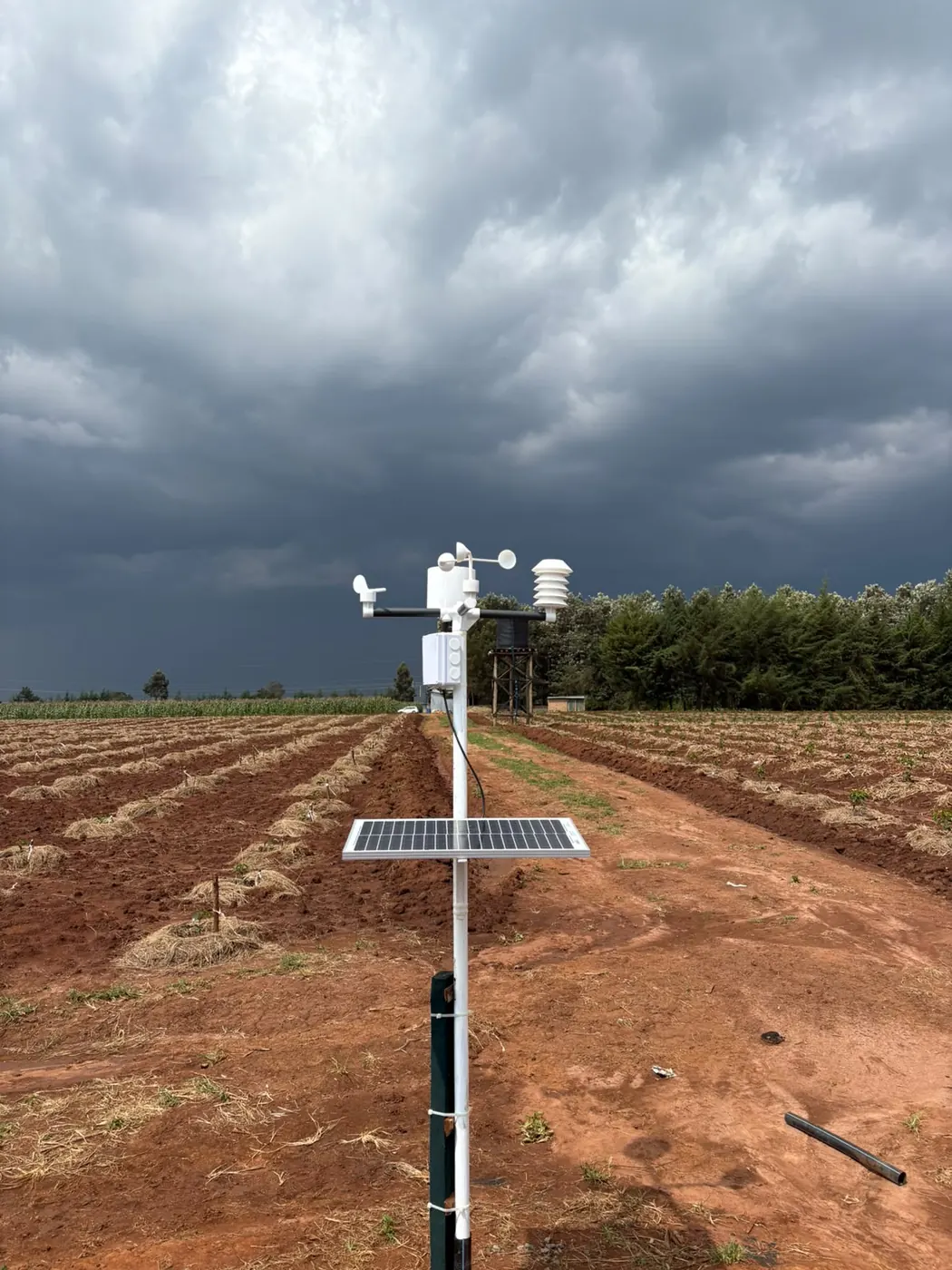
A NuaSense weather station costs KES 30,000. It reports air temperature, humidity, pressure, sunlight, rainfall, wind and direction roughly every ten minutes, and reaches the internet on its own over a Safaricom SIM or Wi-Fi. It is solar powered with no mains needed. Soil sensors connect to the same station over LoRaWAN and cost KES 7,000 to 10,000 depending on variant. They report moisture and temperature at two depths roughly every ten minutes. The dashboard is free with five downloads a day included. Who should not buy one: a farmer whose actual bottleneck is market timing, financing or an aggregation gap. A weather reading fixes none of those. A station earns its keep when the decision in front of you is about water, spray timing or frost risk on your own ground, and you are currently guessing at those from a station kilometres away or from none at all.
IoT applications in Kenyan agriculture covers the low-cost sensor side of this in more depth. It also covers which mobile-based platforms are actually leveraging Kenya's high phone penetration, instead of assuming a smartphone that nobody on a five-acre farm necessarily owns.
Drones: the category that looks most like the future and earns the least on five acres
Drone aerial surveillance appears in the same DAT Challenge list as satellite GIS and blockchain. It is named as an emerging low-cost device category for Kenya, with no figure attached to what it actually costs to run or what it returns. This site's own piece on spray drones against a knapsack works through the acres-per-hour arithmetic and where deposition and drift undercut the speed claim. Nothing in the fact set behind this article changes that conclusion. Drones are a service bought per pass from an operator. A five-acre farm does not typically own them. The honest comparison is against hiring a knapsack sprayer or a hand crew for that same block, not against buying the aircraft.
Satellite GIS and blockchain traceability sit in the same bracket. They are real technologies, used in larger commercial operations. The World Bank lists them as low-cost precision agriculture options, not as tools with a demonstrated smallholder payoff. If a pitch leads with these two, treat it as aimed at a buyer bigger than a five-acre block. Or treat it as a pilot programme, not a commercial product you should pay for out of pocket this season.
Weighing the categories against each other
The table below sorts what a five-acre farm can plausibly run, drawn only from what the sources actually describe, not from invented prices.
- Video and agent-based advisory (Digital Green, Farmers Pride): no purchase, needs a group session or a visiting agent, best when the gap is know-how rather than data
- Phone-based advisory (Precision Agriculture for Development, price and market SMS): no purchase, needs a working number, best for timing and information gaps
- Livestock and input aggregation (DigiCow): subscription-style sign-up, no hardware, best when the constraint is access to a supplier or vet, not information
- Mechanisation hire apps (Hello Tractor): pay per job through the app, best for land prep timed to the rains, weak case for outright tractor ownership on five acres
- Solar irrigation (SunCulture): capital purchase, only workable where vendor financing is actually available, weakest case is buying outright with no financing plan
- On-farm sensors (weather stations, soil probes): fixed hardware cost from KES 7,000 to 30,000, earns back only when the actual decision is about water, spray timing or frost on your own ground
- Drones and satellite GIS: hired per pass or per season, listed as emerging rather than proven at this scale, weakest fit for a standalone five-acre block
Read down that list and the pattern is not technology moving from simple to advanced. The pattern is cost moving from zero to a fixed capital outlay. The earn-back question also shifts. It moves from whether a tool reaches you to whether it measures the thing you actually need measured. A five-acre farmer with a genuine, recurring irrigation-timing problem gets more use from a KES 7,000 soil sensor than from paying for a drone pass every season. A farmer whose real problem is not knowing where to sell gets more from a free SMS advisory than from either.
When no purchase is the right call
Vendors rarely say this plainly: Digital Green and Precision Agriculture for Development require no hardware purchase at all. They exist precisely because a large share of Kenya's slow productivity growth is attributed to low access to extension and advisory services and to a lack of quality data, not to a lack of sensors. If your constraint is knowing what to do, not measuring what is happening, an advisory channel is the correct first tool. It costs nothing beyond the time to engage with it.
Every hardware vendor pitches as if the real constraint is measurement. On many five-acre farms, it isn't. Juma's 2013 review of Kenyan technology adoption studies found real, documented uptake of fertilizer and improved maize varieties through field trials and impact assessments, in the essays on farm technology adoption from Kenyatta University. That is a reminder: on a Kenyan smallholding, the technologies with the longest, best-evidenced record of paying off are agronomic. Seed and fertilizer choice, not sensors or drones. A grower should use up the free and low-cost advisory route, and the input-choice decisions it informs, before treating a hardware purchase as the fix.
Data platforms and the coordination layer above all of this
Every tool in this piece creates or uses some kind of data. A price SMS. A sensor reading. A tractor booking. A vet referral. Kenya's draft Agricultural Data, Information and Digital Policy sets out a national ambition to coordinate that through KADIC, instead of leaving it scattered across competing private platforms. The framework is a coordination mechanism, not a binding rule that any individual farmer or vendor must follow. No source here says otherwise.
For a five-acre farm, the practical point is narrower than the policy language. Compare two competing apps or platforms that both claim to hold your data. Ask which one is more likely to interoperate with a future national system, and which one will lock your records inside a single company's app. A platform that exports data cleanly is worth more over five years than one that does not, even if the second looks slicker today. This matters less than the purchase-versus-hire decisions above. But it is the point most likely to bite a farmer who picks a tool, builds three seasons of history in it, and then finds the company has folded or pivoted.
Putting the sort to use
No category here replaces agronomy. The gap between two tons and five to seven tons per hectare of maize came from inputs, mechanization and training working together, according to the World Bank material. No single tool in this article closes that gap by itself. Each tool can remove one specific bottleneck. A hire app removes the ownership bottleneck on land prep. An advisory channel removes the know-how bottleneck. A sensor removes the guesswork bottleneck on water and spray timing. An aggregation platform removes the too-small-to-service bottleneck on livestock inputs.
Name your actual bottleneck before you name the tool. That is the discipline worth adopting. A five-acre grower who cannot say, specifically, what decision a new purchase would change has not yet earned the purchase, whatever it costs.
Also drawn on for this piece: Draft Kenya Agricultural Data, Information and Digital Policy.