The bucket and the stopwatch come before any box
Automatic drip starts with a bucket, not a box. You can program a controller for forty minutes across three zones, but it means nothing if the pipe cannot feed those emitters at working pressure. The Iowa State guide to using drip in the garden gives you the test. It costs nothing. Hold a five gallon bucket under the tap and time it. If the bucket fills in 30 seconds, the supply is 10 gallons per minute, or 600 gallons per hour. Iowa State then says to plan on using no more than 75 percent of that, which gives 450 gallons per hour. The arithmetic is 0.75 times 600.
That example is a US household tap, measured in gallons. The arithmetic carries over. The figure does not. On a Kenyan block fed by a raised tank, a borehole or a river pump, the number is whatever your bucket and your phone's stopwatch tell you. Run the test where the mainline will connect, at the hour you plan to irrigate. A line shared with the homestead gives less in the morning than at midnight. Usable flow then becomes a budget. Emitters on a zone, times their rated flow, must sit under it. The controller cannot fix an overdrawn line. It only opens the gate.
Backflow, and the rule nobody has written for Kenya
In every US extension design, the first fitting after the source is a backflow preventer. The Arizona extension basics of drip irrigation says all irrigation systems require one, and that county, municipal or local codes regulate how it is installed. If pressure drops on the supply side, water in the drip line can be drawn back into the pipe that also feeds the kitchen tap. That water may be carrying fertiliser if you fertigate. The preventer is a one-way door.
None of the sources say what applies in Kenya. So the honest line is this. If your drip takes from a tank that only feeds the field, the risk is to the tank. If it takes from a county line or a borehole that also supplies the house, the risk is to the people drinking from it. The Water Resources Authority handles abstraction questions; your county water office handles connection rules. Ask them. Automation also makes backflow more likely. A valve opening on its own at four in the morning, while a pump elsewhere on the line has stopped, is exactly the pressure drop the preventer exists for. Nobody is standing there.
The valve is the only part wired to the clock
Now the part the controller actually touches. The Arizona guide puts it plainly. Valves turn the water on or off. They can be manual or automatic, and the automatic ones are wired to the controller. Nothing else in the system is wired to it. The pressure regulator is mechanical. The filter is mechanical. The emitters are plastic. The controller is a clock that sends current down a wire. A solenoid pulls a plunger that lets water through.
Where it goes matters. Iowa State describes automating a garden drip system with a water timer or a solenoid valve connected to a time clock, installed between the filter and the gate valve. It says this is useful when the grower is away. Read that order again. Filter, then the automatic valve, then the manual gate valve. The manual valve stays. It is your override when the clock fails. A system without it has handed every shut-off to a battery.
On power, the Colorado State guidance on drip for home gardens says drip systems can be run with an AC or a battery powered controller. For a Kenyan block with no mains line to the field, that sentence is the whole decision. Battery, or a small panel feeding a battery, with the valve chosen to match. A solenoid built for mains AC is not one that runs on a few dry cells. The dealer must sell the two as a pair, from the same catalogue, or the box will click and the water will not move. One limit to state now. Neither source says how many valves a controller can drive, how long a battery lasts, or what the valve does when the battery goes flat. We come back to that gap. It is the question every grower asks first, and the one the literature leaves open.
Days and minutes: the two numbers the controller knows
Strip off the marketing and the controller does one thing. Arizona defines it. A controller or timer, also called an irrigation clock, is programmed to turn on control valves for a specific amount of time on certain days. That sets how often and how long the system runs. Two numbers: days and minutes. It does not know whether it rained last night, whether the sun is out, or whether the soil is already wet. It does not know the tank is low. It does not know the filter has half closed. It knows it is Tuesday. And Tuesday means forty minutes on zone two.
That blindness is what you're pricing, and real weather shows the price best. Our own weather stations logged station rainfall totals from 0.0 mm to 53.5 mm across 10 stations between 25 September and 25 October 2026. Those stations aren't co-located, so that's a spread between sites, not a regional figure. Still, it proves the point: in the same month one block got nothing and another got more than fifty millimetres. A clock set in September gives the same forty minutes on both. Only 290 of 16,608 ten-minute readings across the network had any rain at all in that period, which is 1.7 percent, so rain comes in short bursts between long dry spells, and a fixed programme is wrong in different directions on the day it rains and the week after. Reference evapotranspiration from FAO-56, computed from 12 of those stations, averaged 1.7 mm per day over the same period. That's reference demand, not crop water use. A controller can't read any of those numbers. The person who programmed it must, and must come back and reprogramme it when the sky changes.
Colorado State puts it plainly: any irrigation system is only as efficient as the schedule it runs on, and a drip system set to over-water can still waste water. The FAO drip irrigation paper in its knowledge repository goes further. It says drip's water savings come from less deep percolation, runoff and evaporation, and depend as much on the person using the equipment as on the equipment itself. A timer is a very obedient user. It will over-water for a month without complaint and under-water for a month without complaint. The crop shows you which only after the damage is done. So for a Kenyan grower the question is: is the problem forgetting to irrigate, or not knowing how much to apply? The clock fixes the first. It makes the second worse, because it removes the daily moment at the tap when a person would have noticed.
The sensor input, and the silence in every source
Here's the gap, plain and simple. None of the eight sources behind this piece describes a soil sensor input on a drip controller. Not the FAO chapter. Not the four US extension guides. Not the USDA report. The Indonesian cassava trial calls its system semi-automated, which tells you a person stayed in the loop. So anything here about sensor-driven controllers is reasoning, not citation. Weigh it that way.
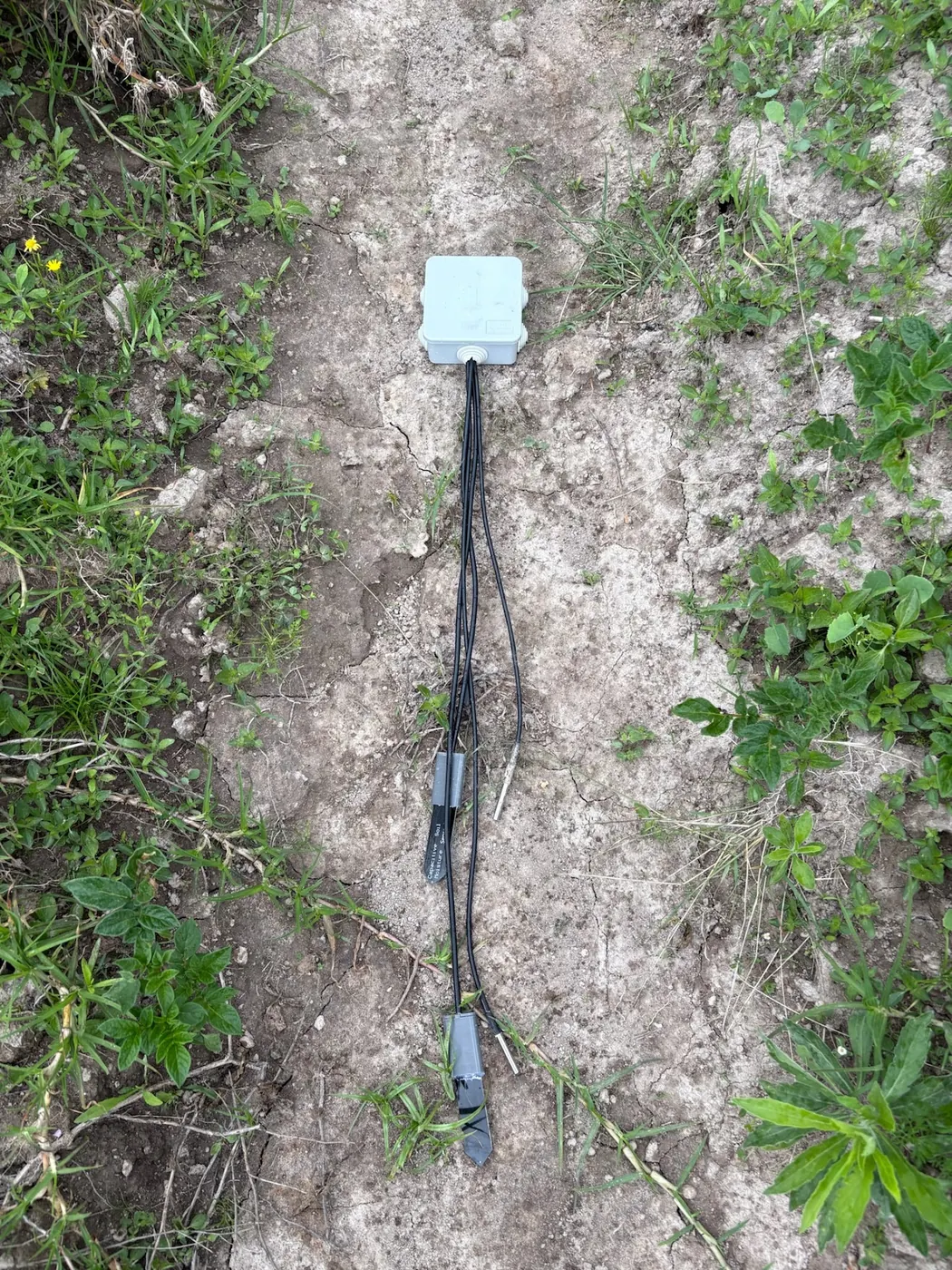
The reasoning runs like this. A sensor input replaces one of the controller's two numbers. The rule changes from 'these days' to 'when the reading drops below a threshold', and the minutes stay fixed. Our own LoRaWAN probes report relative moisture as percent of sensor scale, not calibrated volumetric water content. They read roughly every 10 minutes, at a shallow and a deeper depth. Across 10 of those probes over 25 September to 25 October 2026, the average was 73 percent of scale, with most readings between 43 and 86. That's the signal shape a threshold controller would see: a number on an uncalibrated scale that shifts with soil texture and with how the probe was bedded in. The threshold has to be set per field, by watching the trace against the crop. No dealer can ship it pre-set. The two depths behave differently too. Soil temperature on the steadier depth moved through 1.9 °C over the period, while the more variable one moved through 6.5 °C. Moisture on the shallow probe responds to a cycle long before the deeper one does. A threshold tied to the wrong depth irrigates for the wrong roots.
What matters for the controller is what the rule does when a reading goes missing. A probe goes quiet, a node's battery goes flat, a radio shadow sits behind a store. The box either treats silence as dry and runs, treats it as wet and stops, or falls back to the clock. The sources don't say which, because whoever made the box writes that rule. The question for the dealer isn't 'does it take a sensor' but 'what does it do when the sensor says nothing'. Get the answer in writing. If the dealer can't answer, the box is a timer with a socket on it. Pay a timer's price for it. The irrigation optimisation page on this site covers how station and probe readings feed the scheduling decision. Whether a controller can act on them unattended is a separate question that the controller's own documentation has to answer.
Pull the power, pull the probe, pull the wire
No source describes failure behaviour, so you test it. Three failures, three tests. Do them on a Saturday before the dry season, not during it.
Pull the power. Switch the controller off at the supply, or take the batteries out, wait, and put them back. Then check the programme. The days and minutes are either still there or they're not. The clock either still knows the time or it has reset to a date nobody chose. Write down which. A controller that forgets its programme has to be reprogrammed after every outage. On a Kenyan grid that's a recurring job, not a rare one.
Pull the sensor. If the box takes a probe input, disconnect the probe during a scheduled window and watch the valve. Does it run on the clock, stay shut, or run continuously? The third is the expensive one. A valve that opens on silence and stays open drains the tank into one zone. Do this with the manual gate valve half closed, so the test costs you a wet strip and not a day of pumping.
Pull the valve wire. Then disconnect the solenoid lead. Does the controller flag a fault, or does it just count down the minutes as though water was flowing? Much of what makes the box smart is whether it catches that nothing happened.
These are mechanical checks you do with your own hands, and they carry more weight than anything a brochure says. The FAO chapter on drip irrigation says plainly that automation needs specialist skills and does not suit places where those skills are missing. Doing these three tests and reading the result is the smallest form of that skill. If the tests look like too much, that tells you something useful about whether the box suits you. Better to learn that before you buy than after.
The filter: three mesh numbers that disagree
Water goes through the valve and hits the filter. Here the sources disagree, and the disagreement is worth your attention. Iowa State says you must have a filter with a 100-mesh screen. The Utah State do-it-yourself drip guide says most drip systems need 120 to 200 mesh filtration to catch sediment and debris. Colorado State says in-line emitters flush themselves and resist clogging as long as the system has 200-mesh filters. Three guides, three numbers.
Each guide is answering for a different emitter. The FAO chapter lists emitter waterway diameters from 0.2 to 2.0 mm and says they block when the water is not clean. A ten-fold spread in orifice means a ten-fold spread in what counts as a particle worth stopping. So choose the mesh against the emitter you bought. If the emitter packaging names a mesh, that beats every extension guide.
Cleaning is where the controller turns into a liability. Utah State says inspect and clean filters monthly in the growing season, and weekly when the source water carries heavy sediment or during spring runoff. Spring runoff is a Utah event. Sediment is everywhere, and river or dam water in the Kenyan rains carries more of it than a borehole. Open the tap each morning and you feel the pressure fall as the screen clogs. A controller does not. It runs its minutes through a half-blocked screen while the far emitters get less every day, and nothing says so. Put filter cleaning on a calendar you own.
Ten psi or twenty: the regulator is matched to the emitter
After the filter comes the regulator, and with it the second open disagreement. Arizona says drip systems need low pressure, about 20 psi, and that a regulator brings down supply pressure, which runs from 50 to 75 psi for most water supplies. Iowa State puts a typical household faucet at 25 to 35 psi and says most drip systems run at around 10 psi. Twenty, or ten. That is a factor of two in the working pressure of the same kind of system, from two reputable extension services.
The answer is the same as with the filter. Colorado State explains that emitters come in two kinds: pressure sensitive, which deliver more flow at higher pressure, and pressure compensating, which deliver the same flow across a wide range. It also says newer products are pressure compensating. Push a pressure sensitive emitter above its rating and you wreck the budget you built from the bucket test. A compensating emitter does not mind within its range. So the emitter decides the regulator. Buy a generic regulator in the wrong psi and you quietly over-water the near end of the line and starve the far end.
Take this to Kenya with care. The 50 to 75 psi supply figure is a US mains figure. A tank on a stand gives pressure from height alone, and a gravity-fed block may sit below even the 10 psi end. Then a regulator does nothing, and the real question is whether the emitters will run at all. Before you buy a regulator, measure with a gauge at the mainline, the same way you measured flow with a bucket.
Emitters and spacing, where minutes become litres
Emitters are where the controller's minutes become litres. Arizona lists emitters that usually deliver 0.5, 1, 2 or 4 gallons per hour; Iowa State lists half, 1 or 2. Add up the emitters across a zone and compare that with the usable flow from the bucket test. That is the only way to check the programme can actually be delivered.
Space emitters by soil, not by crop. Colorado State advises 12 inches apart in sand, 18 in loam and 24 in clay, to make up for how far water moves sideways in each. That table was written for Colorado gardens. The physics still holds: on sand the wetted bulb is narrow and deep; on heavy clay it is wide and shallow. Run one line, then dig beside it after a cycle to find your own spacing. The table is a starting point. The hole is the answer.
Three smaller rules can save a season. Colorado State suggests putting two 0.5 gph emitters at the base of a perennial instead of one, so the plant still gets water if one blocks. Colour codes for flow rate differ between manufacturers, so buy every emitter from one maker. Arizona says micro-tubing from the lateral to the plant should not exceed 5 feet. Colorado State puts microsprays at 7 to 25 gph and bubblers at 0 to 35, on a separate zone from drip emitters because they draw more. Count your zones before you count your emitters. The zone count sets which controller you need, and most people discover it after the box is bought.
What a controller costs in Kenya, and why no source says
Now the money. First, what the sources do not contain: a single Kenyan price for a controller, a solenoid valve or a sensor. Not one. Anyone who gives you the typical cost of automatic drip irrigation in Kenya from a web page is guessing, and so would this piece be. What the sources give is the shape of the decision.
The FAO chapter says drip generally only suits high value crops because of the high capital cost of installing a system. It also says a permanent system can easily be automated, which is very useful when labour is scarce or expensive to hire. Utah State notes installation cost can be prohibitive for some home gardeners. Put those together and the controller is the last line on a bill that was already expensive, justified only where the crop pays and labour is the constraint. The Indonesian cassava trial in the AGRIS record of a semi-automated drip system ran on solar panels and grid electricity. It gave 42.4 percent higher yield (110.95 against 77.94 tonnes per hectare) and 34 percent better water use efficiency (4.896 against 3.654 kg per cubic metre). Read the next number before deciding: supplemental irrigation covered only 2.84 percent of total water input. The system was small against the rain, and it is a cassava result from Indonesia that says nothing about a Kenyan tomato house.
The water saving argument is weaker than the sales pitch. Colorado State claims drip exceeds 90 percent efficiency against 50 to 70 for sprinklers. Utah State says well-designed drip can be up to 90 percent. Iowa State says drip can use 30 to 50 percent less water than sprinklers. The USDA Risk Management Agency report on subsurface drip concluded the system did not save much water, though the grower Teeter was able to water more acres with about the same amount. Four sources, four answers, none measured in Kenya, and none about the controller. The saving, where it exists, belongs to the drip. The clock adds none of it.
A figure can go on the sensing side, because we publish ours. A NuaSense soil sensor is KES 7,000 and a weather station KES 30,000, both excluding taxes. The sensor price tiers post on this site sets out what each level buys. Those are instruments, not controllers, and we sell no pipework. Utah State adds one practical saving: some supply stores will design a drip system at no cost if you buy the supplies from them. Ask the Kenyan dealer the same question. The design is the skilled part.
A tap and a watch: when no purchase is the right answer
The sentence that should decide most small holdings is FAO's: automation requires specialist skills and is unsuitable where such skills are unavailable. Not the hardware. The skills. A controller on a one-acre block owned by someone who walks it every morning turns a free glance into a paid dependency. If you are on the farm and the tap is near the house, a tap and a watch is the right answer. In every year that nothing breaks, the cheaper option wins.
What justifies the box is absence and scale. Iowa State's case for a timer is that it helps when the grower is away. FAO's is that labour is scarce or costly to hire. If you are managing blocks in two counties, or running a flower house where the night cycle matters, or the bucket test shows the supply can only run one zone at a time and three have to be sequenced, then the clock earns its place. Without those conditions, buying one is sentiment. The NuaSense overview of smart irrigation in Kenya covers low-cost drip kits and gravity-fed systems, and that is where a first block should start. The controller comes after the drip has proved itself.
How it fails, in the order it fails
Everything above fails in a set order, and that order is the argument. Begin with the quietest failure. Water seeping at ground level is hard to see, Colorado State notes, and it makes it difficult to know whether the system is working at all. The fix it offers is an indicator device that raises and lowers a flag to show flow. Iowa State says emitter clogs often go unnoticed until plants wilt or die. Put the two together and the lesson is not a smarter timer. A controller counting minutes while a flag stays down is the worst case: it tells you it ran, and nothing moved. Fit the flag. It answers the one question the controller cannot.
Dirt is not the only cause of blockage. FAO lists algae, fertiliser deposits, and dissolved calcium and iron that precipitate inside the waterway, and says sorting these out may need an experienced engineer or the dealer. Fertigation through drip and hard borehole water are both common here, so on a Kenyan block both causes are live.
Then there are the roots. FAO warns that crops watered every day may develop only shallow roots, so if the system breaks down the crop may start to suffer very quickly. A daily clock trains a crop to depend on the clock, and the automation raises the cost of its own failure. Longer, less frequent cycles are the programme that protects you, and the box will run them if you tell it to.
Then the pipe. FAO says mainlines, submains and laterals should be buried because they degrade in direct sun. Colorado State's list of common mistakes closes it out: no filter, no pressure reducer, mainlines too long, too many emitters. Not one of those four is a controller fault. The controller opens a valve on time, every time, onto whatever sits downstream. If what sits downstream is wrong, automation delivers the mistake punctually.